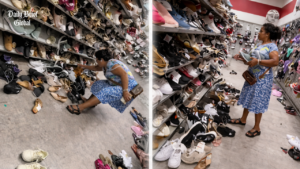
A heated confrontation captured inside a San Antonio thrift store has ignited a fierce online debate over public harassment, accountability, and the power of social media call-outs. The video, posted by TikTok user Leah (@yofattie), shows a tense exchange that quickly drew millions of views, prompting sharply divided reactions between those who viewed the incident as an act of survivor advocacy and others who questioned the evidence and circumstances surrounding the accusation.
The incident-in which the creator confronts a man, his wife, and their young child over an alleged inappropriate touching of her back—serves as a case study in how public spaces, immediate family dynamics, and social media platforms respond to allegations of non-consensual contact. Watch:
"When the systems meant to protect us require an impossible burden of proof, the smartphone camera becomes the only weapon left to reclaim bodily autonomy in a public space."
Inside the Viral Thrift Store Confrontation
Videos showing alleged harassers being confronted in public have become a familiar feature of social media platforms such as TikTok. In this case, the viral exchange unfolded across several layers, reflecting not only the immediate accusation itself but also the complex psychological and social dynamics that often emerge when such incidents are recorded and shared online.
The Public Confrontation
By recording the encounter inside the store, the creator transformed what might otherwise have remained a private dispute into a public confrontation. Allegations of inappropriate touching often occur in situations where victims may hesitate to respond immediately due to shock, uncertainty, or fear of causing a scene. In this instance, the decision to film the interaction brought the allegation into full view of store employees and other shoppers, placing the accused under immediate public scrutiny.
The Family's Response
One of the most notable aspects of the video is the reaction of the man's wife, who quickly moved to defend her husband and challenge the accusation. Such responses are not uncommon when allegations arise in front of family members. In highly emotional situations, relatives may instinctively seek to protect a loved one, often prioritizing loyalty and family cohesion while questioning or disputing the claims being made.
The Question of Evidence
The creator's request to review store surveillance footage, along with her decision to document visible marks on her arm and file a police report, highlights the central role evidence plays in cases involving alleged unwanted physical contact. Because such incidents frequently occur without clear witnesses or definitive physical proof, surveillance recordings and formal reports can become critical in establishing an objective account of what occurred and determining whether the allegations can be substantiated.
The Digital Court of Public Opinion
When videos like this are uploaded to TikTok, they transcend the local geographic boundaries of San Antonio and enter a broader cultural discourse. The digital reception generally fractures into two distinct camps:
| Perspective |
Core Argument |
Social Driving Force |
| Survivor Advocacy |
Validates the creator's anger; emphasizes that "minor" unwanted touching is a violation of bodily autonomy and systemic public harassment must be confronted. |
Believe Victims movement; pushback against public space normalization of harassment. |
| Skepticism & Due Process |
Questions the severity or intent of the contact; criticizes the public filming of a suspect in front of a child before formal law enforcement validation. |
Concern over digital vigilantism and permanent reputational damage without structural trials. |
The episode highlights the complex role of social media in modern accountability. Smartphones and social platforms give individuals the ability to document incidents instantly, creating a digital record that can amplify their experiences and attract widespread public attention. At the same time, these recordings are subjected to intense scrutiny, with millions of online viewers dissecting gestures, reactions, body language, and context before forming their own conclusions.
The debate also underscores the gap that can exist between public opinion and legal processes. In Texas, certain forms of unwanted physical contact may constitute assault or offensive contact under state law. However, legal proceedings often depend on establishing intent and evaluating evidence within a formal investigative framework. When incidents are captured on limited footage or occur in crowded public settings, determining what happened can become challenging, prompting many people to turn to social media as a platform for raising concerns and seeking accountability.
The Role of Corporate Responsibility
An important dimension of incidents like these is the role played by the businesses where they occur. Retail stores increasingly find themselves caught between customers seeking immediate action and the legal obligations that govern privacy, security, and evidence handling. When disputes arise, businesses often rely on established protocols that restrict access to surveillance footage, releasing recordings only to law enforcement or authorized investigators.
While such policies are designed to protect privacy rights and limit legal liability, they can leave individuals involved in an incident feeling frustrated or unsupported in the moment. As a result, many people turn to smartphones and social media as an alternative means of documenting events, creating their own record when official channels may take time to respond.
Final Thoughts
The incident reflects a broader shift in how allegations of public misconduct are addressed in the digital age. Traditional approaches that encouraged victims to quietly report incidents through formal channels are increasingly being challenged by a generation more willing to document, publish, and publicly discuss their experiences in real time.
Regardless of the outcome of any police investigation, the viral response demonstrates how social media has become a powerful force in shaping public narratives. The case highlights the complex intersection of personal safety, public accountability, family dynamics, and online discourse, illustrating how quickly local incidents can evolve into national conversations in an increasingly connected world.
How do you view the rise of digital "receipts" in public spaces? Does real-time filming serve as a necessary shield for personal safety, or does it risk bypassing the essential guardrails of due process?
Share your thoughts in the comments below, share this article with your network, and let us know where you draw the line between public accountability and digital vigilantism.
Disclaimer:The views and analyses expressed in this article are based on publicly available video footage and social media reports. This piece is intended for cultural and analytical purposes and does not constitute a legal judgment. All individuals involved are presumed innocent unless proven guilty in a court of law.
Other Viral Content