Published On: May 10, 2026
Hungary officially entered a new political era this week after was sworn in as the country’s new Prime Minister following a landslide election victory that ended Viktor Orbán’s 16-year rule. The inauguration took place on May 9, 2026, inside the Hungarian Parliament building in Budapest after Magyar’s centre-right Tisza Party secured a powerful two-thirds parliamentary supermajority in April’s national election.
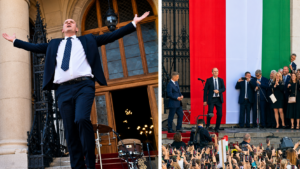
But it was the celebration outside Parliament that quickly exploded online. A viral video shared across X and TikTok shows incoming Health Minister dancing energetically on Parliament steps while crowds cheered, waved flags, and recorded the moment on their phones. The festive atmosphere included live music, applause, and symbolic pro-European gestures, including the return of the European Union flag to the Parliament building. Inside Parliament, lawmakers also reportedly sang “Ode to Joy,” the EU anthem, marking what many observers described as a dramatic political and symbolic shift for Hungary.
The significance of this transition goes far beyond a viral dance clip. For more than a decade and a half, Hungary under Viktor Orbán became one of Europe’s most politically controversial governments, often clashing with the European Union over media freedom, judiciary independence, migration policy, and democratic standards.
once connected to Orbán’s political circle before becoming an opposition figure — built his campaign around anti-corruption promises, economic reforms, stronger EU relations, and restoring institutional trust. The scale of the election victory matters enormously because a two-thirds majority gives the new government enough power to introduce constitutional and structural reforms without needing opposition support. The public celebrations therefore reflected more than excitement over a single politician — they represented a feeling among supporters that Hungary may be entering a major political reset after years of division.
Reaction online has been intensely polarized both inside Hungary and internationally. Supporters celebrated the inauguration as a hopeful democratic transition, praising the festive mood outside Parliament and calling the moment “historic” for Hungary’s future relationship with Europe.
Critics and Orbán supporters, however, expressed concern that the new government may move Hungary closer toward EU influence at the expense of national sovereignty and conservative policy priorities. Meanwhile, the viral dancing clip itself became a major social media talking point. Some users found the celebration refreshing and humanizing, while others criticized it as overly theatrical for such a serious political moment.
Important Facts About Hungary’s Political Shift:
One important reality is that Hungary’s electoral system gives enormous governing power to parties that secure strong parliamentary majorities. Because the Tisza Party won a two-thirds supermajority, the new government can potentially reshape institutions, amend constitutional provisions, and influence long-term national policy far more aggressively than many coalition governments elsewhere in Europe.
Another key factor is Hungary’s relationship with the European Union. In recent years, billions in EU funds were frozen or delayed because of disputes involving corruption concerns and rule-of-law standards. Political analysts believe improved relations with Brussels could significantly affect Hungary’s economy, investment climate, and international partnerships moving forward.
At the same time, supporters of Orbán argue his government prioritized national identity, immigration control, and independent policymaking in ways they fear may now weaken under the new administration. This is why the election outcome has attracted major attention far beyond Hungary itself.
Credits
Viral celebration footage originally circulated through X account @Alex_Oloyede2. Additional reporting and ceremony details based on Reuters, AP, BBC, DW, AFP, and official Hungarian parliamentary coverage.
After taking office, stated: “I will not rule over Hungary — I will serve my country.” Parliamentary leadership also described the return of the EU flag as a symbolic first step toward renewed European cooperation. This article is based on verified international reporting, official parliamentary information, and publicly circulated footage available as of May 2026. Political developments and policy changes may continue evolving in the coming months
Do you think Hungary’s political shift will strengthen the country’s future — or create new divisions across Europe? Share your respectful thoughts below.👇