Published On: May 3, 2026
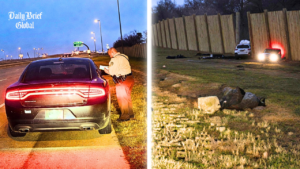
A routine nighttime traffic stop on an Oklahoma highway turned into a terrifying near-fatal crash when a speeding vehicle suddenly veered onto the shoulder and slammed into a pulled-over sedan — missing a police officer by mere feet.The shocking dashcam footage shows flashing patrol lights illuminating a dark multi-lane roadway as an officer stands beside a stopped black sedan during what appears to be a standard roadside enforcement stop. For several calm seconds, nothing seems unusual. Then, out of nowhere, a fast-moving vehicle drifts sharply from the active traffic lane straight toward the shoulder. Before anyone has time to react, it plows into the rear of the stopped sedan at high speed. The impact launches the car forward violently, scattering debris across the shoulder while the officer leaps backward in a split-second survival move. Had he been standing just one step closer, the crash could easily have become a line-of-duty fatality caught on camera. No detailed official injury report has yet been widely released, but the footage alone shows how close this came to tragedy.
Why Highway Traffic Stops Are So Dangerous:
Many people think the danger in police work comes only from armed suspects. In reality, one of the most statistically lethal environments for officers is the highway shoulder. When a driver is pulled over, both the officer and the stopped motorist become stationary targets just feet away from vehicles traveling 60 to 80 miles per hour — often at night, in low visibility, with distracted or fatigued drivers passing inches away. Add flashing lights, which can confuse or mesmerize impaired motorists, and the roadside becomes a narrow corridor of extreme vulnerability. This Oklahoma footage captures that threat perfectly: the officer was not facing violence from the driver he stopped — he was facing violence from ordinary traffic.
What makes this video especially unsettling is how ordinary the first few seconds look. No chase. No gunfire. No confrontation. Just paperwork and patrol routine. That normalcy is exactly why these incidents are so deadly: there is almost no psychological warning before impact. Experts often refer to these as “secondary strike incidents” — crashes where uninvolved passing motorists become the actual threat. Possible causes typically include: phone distraction, fatigue, drunk driving, rubbernecking at police lights or simple lane drift. Whatever the exact cause here, the dashcam demonstrates a brutal truth: on highways, danger can arrive from behind faster than any officer can fully prepare for.
The video spread rapidly across X and law-enforcement pages, where viewers repeatedly replayed the exact frame showing the officer jumping away from the blast zone. Many commenters praised his reflexes and called it one of the narrowest roadside escapes they had seen in recent footage. Others shifted the discussion toward highway stop procedure, asking whether officers should conduct minor stops only after directing drivers to exit ramps or safer lit areas whenever possible. At the same time, many users focused blame squarely on the striking driver, noting that emergency lights should make shoulder presence obvious from a long distance.
Routine Tasks Often Produce the Deadliest Moments:
This footage is a reminder that tragedy rarely announces itself with drama. Some of the deadliest incidents in policing, towing, roadside assistance, and civilian breakdowns begin as utterly routine moments on the shoulder. A taillight violation, a flat tire, a stalled engine — then one drifting car changes everything. That is why roadside professionals often say: the scene you think is under control may still be the most dangerous place you stand.
Credits:
🎥: @JOKAQARMY1 on X
No detailed official law enforcement statement regarding this specific crash had been widely released at the time the footage circulated publicly. This article is based on publicly available dashcam footage and social media circulation as of May 2, 2026. Full police findings, injury details, and any charges may be released later by Oklahoma authorities.
Do you think police should avoid routine traffic stops on busy highways whenever possible? Share your thoughts below.👇